
New FIMs probes and co-formers
This blog highlights new enhancements to Full Interaction Maps (FIMs), including four additional interaction probes and an expanded co-former library to support crystal structure analysis and co-crystal design.
For crystallographers and drug discovery scientists, these updates provide more precise tools for assessing intermolecular interactions, evaluating polymorphism risk, and identifying promising co-crystal candidates. By leveraging knowledge from the Cambridge Structural Database, researchers can gain deeper insights into crystal packing behaviour and make more informed decisions during solid-form development.
Key takeaways
- Four new FIM probes have been added: sp² CNC nitrogen, carboxylate oxygen, nitro oxygen, and chloride anion.
- The new probes enable more chemistry-specific interaction analysis, improving assessment of crystal structures and interaction networks.
- Enhanced interaction mapping can help identify unusual interactions that may indicate a risk of polymorphism.
- FIMs support the comparison of expected and observed interactions, providing valuable insights for crystallography studies.
- The co-former library has been expanded with 249 additional compounds, strengthening in silico co-crystal screening workflows for pharmaceutical and agrochemical research.
These updates make it easier to explore crystal interactions and accelerate solid-form selection in drug discovery and materials development.
New Full Interaction Map probes
Full Interaction Maps (FIMs) allow a user to generate a picture of potential interaction sites around the molecules in a crystal structure. These use statistical distributions from the more than 1.4 million entries included in the Cambridge Structural Database, predicting the most likely locations of interaction for a variety of functional groups. These can be compared with the observed interactions in the structure being analysed, to identify if the crystal structure fulfils the expected interactions of the conformation of the molecule(s). This is important to highlight the potential for polymorphism, as well as assisting in the development of co-crystals.
Four additional probes have been added to Full Interaction Maps for CSD-Materials, CSD-Discovery, and CSD-Enterprise users:
- sp2 CNC Nitrogen
- Carboxylate Oxygen
- Nitro Oxygen
- Chloride Anion
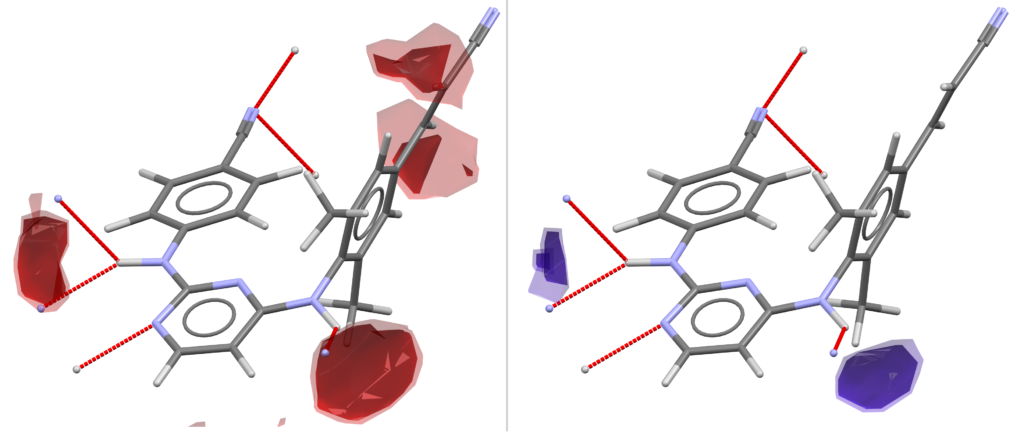
These probes enable users to rapidly visualise more specific interactions, focussing on the chemistry which matters for that molecule. This in turn allows for more specific risk assessment of the interactions within a structure, compared with the desired interactions of the molecule within that structure. For example, as seen in the figure, a FIMs analysis of CSD entry OMAKOE01 differs when using a carbonyl oxygen as a generic acceptor probe versus an sp2 CNC nitrogen probe, which more accurately represents the hydrogen bond acceptor. With FIMs set to show the 4.0 and 6.0 levels, the nitrogen acceptor for the N-H donor is within the red carbonyl oxygen ‘cloud’ but on the edge of the blue sp2 CNC nitrogen ‘cloud’. This shows that this interaction is slightly unusual compared with other similar interactions in the database, and contributes to a potential for polymorphism.
Expanded co-former library
Co-crystals offer an alternative in pharmaceutical and agrochemical solid-form selection. In our scripts and software for CSD‑Materials and CSD‑Enterprise we provide in silico screening approaches to narrow co-formers down to those most likely to form co-crystals, including multi-component hydrogen bond propensity, the interaction analysis prototype script and the molecular complementarity tool (within its domain of applicability). These tools require a library of co-formers. In the 2026.2 release, we have added 249 co-formers to the existing Mercury library, derived from the list used by Grecu et al., Crystal Growth & Design 2014, 14 (4), 1749–1755.
For each new co-former we generated a 3D conformation using the CSD Conformer Generator. For carboxylic acids we inspected and adjusted hydrogen positions where needed to change conformation from anti to syn. All co-formers are stored in Tripos MOL2 format alongside the existing entries.