
Highlights and insights from our Summer conferences
The busiest months for conferences may feel like a distant memory now, but it wasn’t that long ago that we were travelling from one event to the next, meeting researchers, hearing about new scientific developments, and learning how the CSD and tools are being used by our community to help advance science. Here is a look back at some of the meetings that kept us busy over the UK summer months.
While each conference had its own focus, a few themes kept appearing. From crystal engineering and materials science to biochemical engineering and drug discovery, the scientific community is asking similar questions around data quality, accessibility, AI, and how to make the most of increasingly complex scientific datasets.
Attending conferences is about meeting and listening to our community, and some of our most valuable insights come from conversations over coffee, discussions at posters, questions after talks, and visits to our exhibition stand. These interactions help us understand the challenges facing our community and shape the future development of the CSD, software and services.
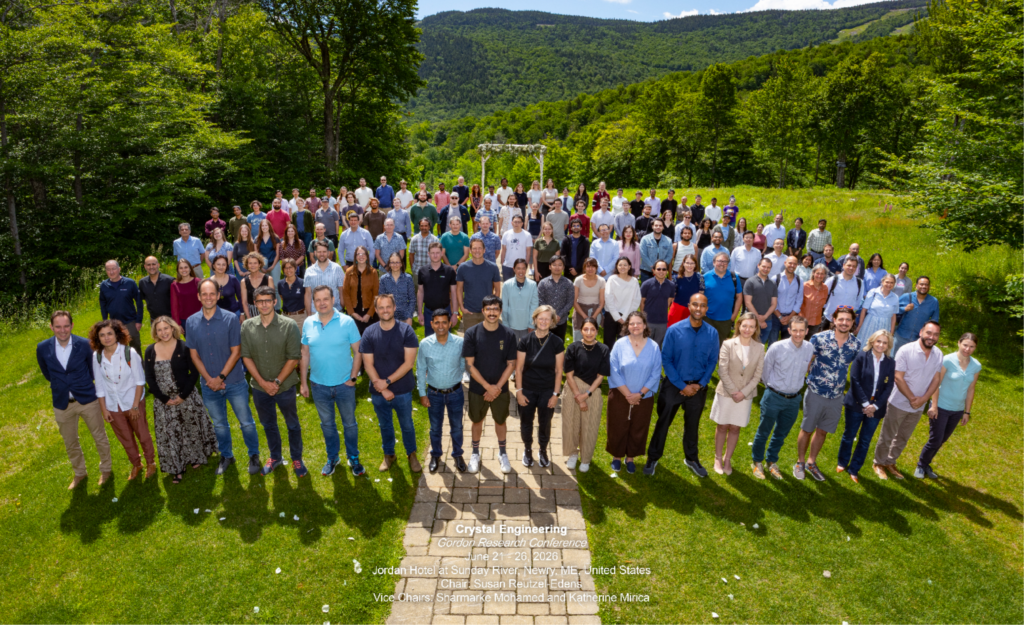
The biennial Crystal Engineering Gordon Research Conference in Maine (US) is always a highlight for members of the CCDC Materials team. As in previous years, we were delighted to hear researchers from both academia and industry mentioning CCDC tools throughout their presentations. One particularly exciting topic was crystal structure prediction (CSP), where several talks showcased the growing role of machine-learning interatomic potentials. Beyond the agenda, the conference provided plenty of opportunities to exchange ideas with the community and hear first-hand about emerging challenges and opportunities in materials research.
One topic remained unsolved throughout the week, however: where exactly was the conference’s famous black bear? Despite numerous reports, we are still waiting for photographic evidence.
At the BACG Biochemical Engineering meeting in Manchester (UK), we felt like we were joining a group of close friends enjoying some familiar discussions: issues of data quality and accessibility, topics that resonate strongly with many of the challenges we see today across scientific research. We had some fascinating conversations around nucleic acids, RNA and DNA research, as well as discussions on how computational methods can better support experimental workflows. One particularly interesting conversation explored the use of fragment-based approaches in peptide design and the ongoing challenge of connecting in silico predictions with laboratory outcomes.
We also attended the 9th MABC: Machine Learning and AI in Biochemical Engineering, in Cambridge (UK), and the message we heard the most was simple: data matters. Across two packed days of talks and posters, presenters explored how machine learning and AI can be applied to experimental chemistry, from reaction prediction and yield optimisation to molecular design and property prediction. Large language models appeared throughout the programme, but many speakers also highlighted their limitations. Several discussions focused on the risks of relying on AI-generated data without careful validation, reinforcing a point that resonates strongly with our own experiences: the quality of a model depends on the quality of the data behind it.
What stood out most was how often conversations returned to familiar challenges: finding enough data, ensuring that data is reliable, and making it accessible to the people who need it. These are challenges that affect researchers across disciplines, and they are exactly the kinds of conversations we value hearing from our community.
The 3rd Workshop on Benchmarking Solid-State Properties, in Lisbon (PT), focused on one of the field’s most important challenges: understanding which material properties can be predicted reliably and where theoretical methods still have limitations. We’ve joined presentations on particle science, electron diffraction, and industrial research applications, showcasing the breadth of research supported by the CSD. It was particularly rewarding to see how widely the CSD is being used and to hear the different perspectives, experiences, and challenges being shared throughout the conference. These discussions reinforced the value of working closely with our community to advance the science together. The CCDC team also presented on the CSP Physical Properties Blind Test, which generated considerable interest and recognition for its combination of experimental data, theoretical insight, and the benchmark itself. Many of the questions that followed the presentation focused on the future impact of the work and how these benchmarks can help researchers distinguish between problems that are already within reach of current computational approaches and those that remain significant challenges.
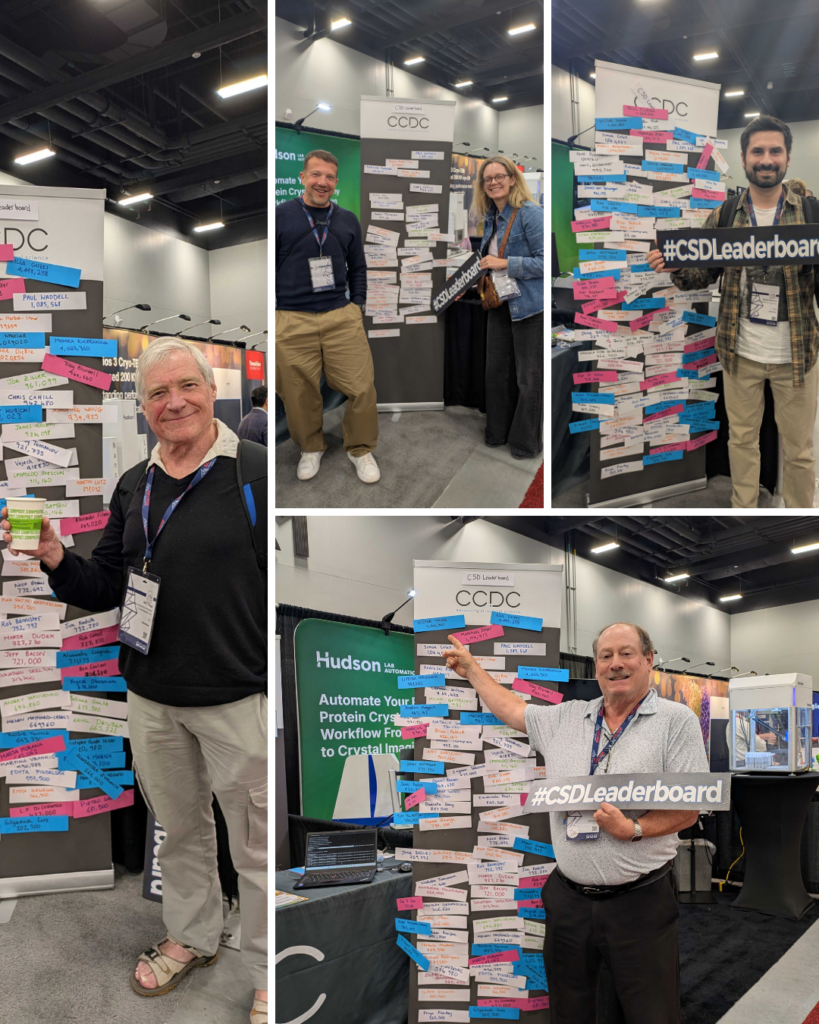
The IUCr Congress in Calgary (CA) was one of the largest conferences of the summer for the crystallographic community and offered countless opportunities to connect with crystallographers worldwide. With nearly 2,000 attendees representing more than 55 countries, the congress brought together researchers from across academia, industry, and scientific infrastructure organisations. The CCDC team was at talks, workshops, posters, exhibition activities, and community initiatives. While sharing our latest developments was important, some of the most valuable moments came through conversations at the exhibition stand, where researchers shared their current challenges and what they would like to see from the CSD and CCDC tools.
Our CSD Leaderboard challenge at our stand was, without a doubt, our most popular activity throughout the week, with 125 scientists taking part: some were new to this challenge, and some were old friends, keeping the competitive spirit alive. These interactions often led to wider discussions about new functionality and workflows. We also heard strong interest in developments related to CSD Particle and future particle science capabilities.
The congress also provided opportunities to engage with the next generation of scientists. A new outreach activity introduced young learners to the concepts of databases, data storage, and searching the CSD. Although the audience was younger than expected, the team quickly adapted the format into an interactive scientific mystery and received enthusiastic feedback from participants. Across sessions, workshops, and informal conversations, several themes emerged repeatedly: open and FAIR data, data quality, accessibility, education, and the challenges of managing both experimental and computational data. These discussions reinforced how central data remains to modern scientific research and how important it is to keep listening to the community’s needs as those challenges evolve.
At the International Symposium on Industrial Crystallisation (ISIC) in Budapest (HU) we had an excellent opportunity to meet with academic and industrial researchers working in the field of crystallisation science. Throughout the meeting, we enjoyed conversations with researchers from pharmaceutical companies, instrument manufacturers, and academic institutions. Many of these discussions centred on how structural data and computational tools can support crystallisation workflows, from early-stage development through to manufacturing. It was also encouraging to see CSD data and CCDC tools referenced in presentations beyond our own, highlighting the important role crystallographic data continues to play across the scientific community.
One topic that generated particular interest was DigiCCAMMS. Visitors frequently stopped by the stand to ask about the new tool, its capabilities, and when it might become available. The level of enthusiasm showed just how eager researchers are for new ways to visualise and analyse crystallisation data.
Finally, the RSC BMCS Fragment-Based Discovery meeting in Cambridge (UK) had a clear focus on how computational methods are evolving and how they can be combined with experimental approaches to tackle increasingly complex drug discovery challenges. While most of our interactions with academic colleagues took place during presentations and poster sessions, the informal discussions were great opportunities to share experiences and learn about ongoing research activities. We discussed how structural data, computational chemistry, and database technologies can work together to support discovery programmes.
We returned inspired, with plenty of ideas for future projects and collaborations and a growing list of researchers we would love to invite to our future virtual events and internal journal club. By meeting and listening to our community, we gain a better understanding of how the CSD and CCDC tools can continue to support the community’s needs.
If you met the CCDC team at any of these conferences and would like to continue the conversation, or if you have any questions that we didn’t have the chance to answer, we’d love to hear from you. Please get in touch by emailing us at hello@ccdc.cam.ac.uk.
Want to see where CCDC is headed next? Visit our website’s events page.