
Science Day 2026: recognising student research, collaboration and scientific discovery
A look back at this year’s Science Day, celebrating student achievements and the impact of our research community.
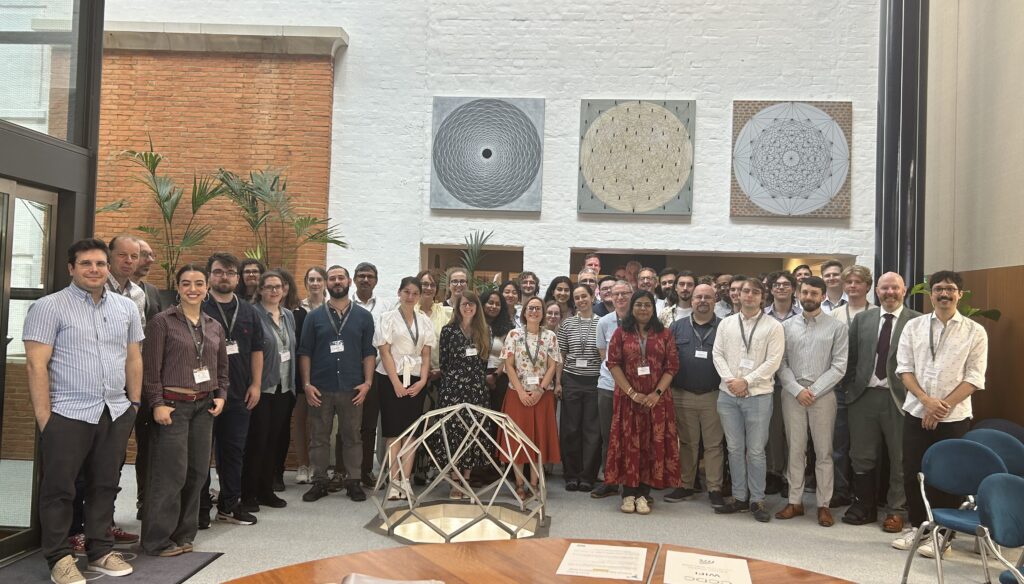
The annual Science Day meeting is organised by the CCDC supervisors and wider team to welcome our sponsored students and hear about the latest developments in their research. It is a day to listen, learn, and share knowledge, while also making time for networking and friendly conversations.
This year, we heard from students in the final stages of their studies and welcomed a few new students. While it is always a little sad to see students move on, it is also incredibly rewarding to have witnessed their progress and to celebrate everything they have achieved. At the same time, our new students bring fresh ideas, exciting possibilities, and renewed enthusiasm for scientific discovery.
The Science Day meeting continues to be a valuable opportunity to connect with our students, recognise their achievements, and explore the diverse ways crystallographic data and computational methods are advancing scientific research. From crystal engineering and pharmaceutical solid forms to machine learning and drug discovery, this year’s presentations showed the impact and relevance of the work being carried out by the CCDC-sponsored PhD students.
In this blog, we highlight the research and achievements presented during this year’s meeting.
Alex Lee is finishing his PhD at Durham University, and his research explores the use of crystallographic phenomena as alternative sources of chirality in organic synthesis. He investigates how conglomerate crystallisation can create enantiomerically enriched crystals from racemic materials, through processes such as Viedma ripening.
By synthesising and screening 2-amino-4H-chromene derivatives, Alex identified factors that promote conglomerate formation and significantly improved discovery rates through a targeted screening approach. His work also shows that solid solutions can induce conglomerate behaviour in compounds that would not normally exhibit it, providing new opportunities for chiral enrichment and crystal engineering.
William Midgley from Durham University is researching computational PROTAC design. He has developed a workflow that combines docking, linker generation, conformer modelling, and molecular dynamics simulations to identify PROTAC candidates capable of forming stable ternary complexes.
A key focus of his work is optimising linker design and improving scoring methods to predict effective PROTAC conformations better. His research is currently being applied to EBNA1, a protein associated with Epstein–Barr virus-related cancers and multiple sclerosis, to accelerate the discovery and prioritisation of promising PROTAC therapeutics.
Aaron Horner is a fourth-year PhD student in Simon Coles’ group at the University of Southampton. In his last year presenting at the Science Day annual meeting, Aaron mentioned what motivated him to start his PhD with CCDC: “I had the opportunity to work as a summer student with CCDC, and found that I learned a lot during this period. It furthered my own interest in data science, and it felt like a good direction to take a PhD if I were able to. I’m fortunate to say I was.”
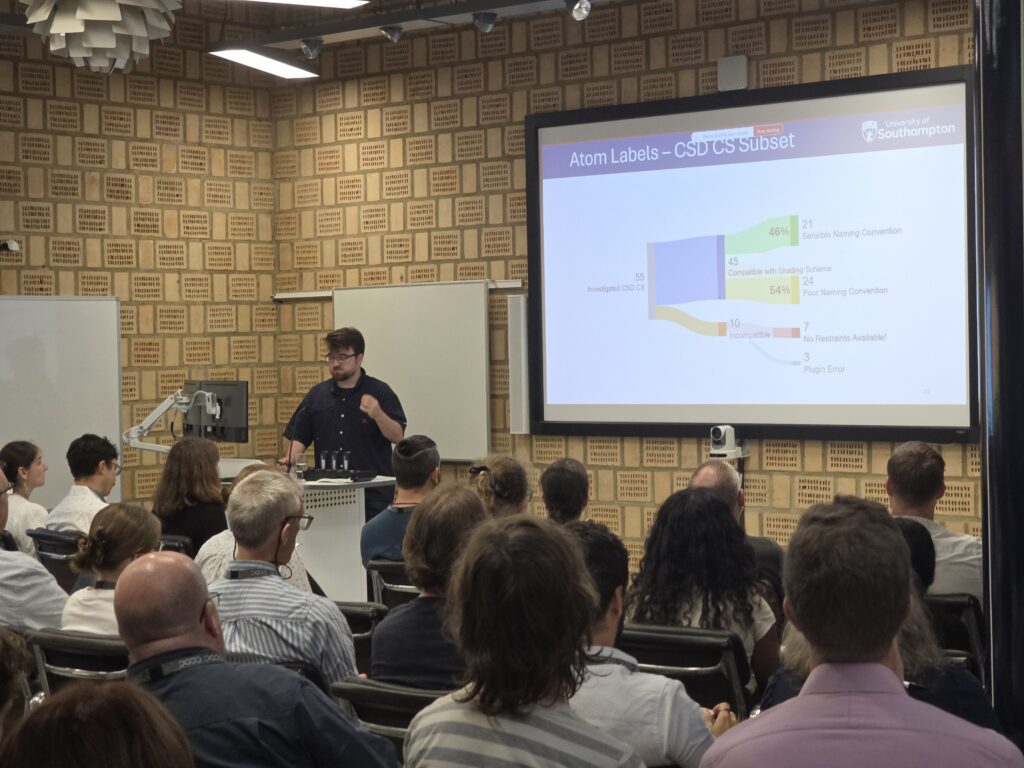
Aaron’s research focuses on assessing crystal structure quality, particularly for challenging crystal sponge structures where traditional metrics such as the R-factor are often insufficient. He has developed automated tools, including the Distortion Score, Weighted Ratio, and Bond Likelihood methods, to provide more reliable measures of structural quality and identify problematic refinements. By enabling large-scale analysis of crystallographic datasets, his work supports improved data quality, standardisation, and future applications in data-driven crystallography and materials discovery.
Sarah Madeira, also from the University of Southampton, presented her work on crystal structure prediction (CSP) for organic photocatalysts used in sustainable hydrogen production. Her research investigates how crystal packing affects charge transport in organic photocatalysts. Using CSP, she successfully predicted experimental crystal structures for known photocatalysts and generated energy-structure-mobility maps to understand their performance. A key challenge is the high computational cost of calculating crystal structures and electronic properties.
Matthew Shaw from the University of Leeds presented his research on using machine learning to predict crystal habits. Crystal shape plays an important role in pharmaceutical manufacturing, affecting properties such as processability and solubility. Current prediction methods can be computationally expensive, so Matt is exploring data-driven alternatives using CSD data. His work involves building machine learning models to classify crystal habits as block, needle, or plate using molecular and crystal structure descriptors. While initial models have shown limited accuracy, including 3D crystal structure information appears to improve performance.
Paulo Nunes from the University of São Paulo is focusing his research on improving the solubility and bioavailability of an anti-HIV drug through the development of new salt forms and co-crystals. Using computational screening, Paulo has evaluated a wide range of organic and inorganic co-formers, leading to the preparation of several new solid forms. He is currently characterising these materials using crystal structure modelling, charge density analysis, and X-ray constrained wavefunction refinement to understand how structural changes affect key pharmaceutical properties. His goal is to establish structure–property relationships that support the design of more effective drug formulations.
Henry Holleb, in the final year of his PhD at Durham University, is researching the prediction and control of hydrate formation in pharmaceutical salts. Using over 31,000 crystal structures from the Cambridge Structural Database (CSD), he investigates how the choice of counterion influences a salt’s tendency to form hydrates. By combining crystallographic data analysis with electrostatic potential calculations, Henry has shown that charge localisation is a key factor governing hydration behaviour. His work identified clear trends across several families of counterions and enabled the development of predictive models that estimate hydrate propensity, even for systems with limited experimental data. He has successfully validated these predictions through experimental salt screening, demonstrating that counterions with more diffuse charge distributions are less likely to form hydrates. His research provides a practical framework for selecting counterions and designing more efficient pharmaceutical solid-form screening strategies.
Henry James Broster from the University of Oxford is combining machine learning and physics to improve molecular docking and generate ligand-binding poses that are both accurate and physically realistic. His recent work uses reinforcement learning to teach diffusion-based docking models to optimise for physical validity, rather than relying solely on traditional measures such as RMSD. By incorporating physics-based criteria, including PoseBusters validation and interaction recovery, his approach produces higher-quality docking predictions and improves performance on challenging protein–ligand systems. This research demonstrates how machine learning and physics-based methods can be combined to generate more reliable molecular docking models, supporting drug discovery applications where both accuracy and physical plausibility are essential.
Omar El-Habak is in the final year of his PhD at the University of Strathclyde, working with CMAC in collaboration with AstraZeneca. His research focuses on using machine learning to predict pharmaceutical powder flowability from experimental and computational particle properties. By combining laboratory measurements of particle size, shape, and flow behaviour with crystal structure descriptors generated from CCDC tools, Omar has developed predictive models that classify powders according to their flow performance. His work integrates data curation, crystal form matching, morphology prediction, and synthetic data generation to improve model accuracy despite limited experimental datasets.
As he enters the final stage of his PhD, Omar reflects on his journey as a CCDC-sponsored student: “The most rewarding part was by far my CCDC placement, underscored by the warm, friendly environment and how quickly my project progressed in a short period of time from being around people who knew the CSD Python API inside and out.”
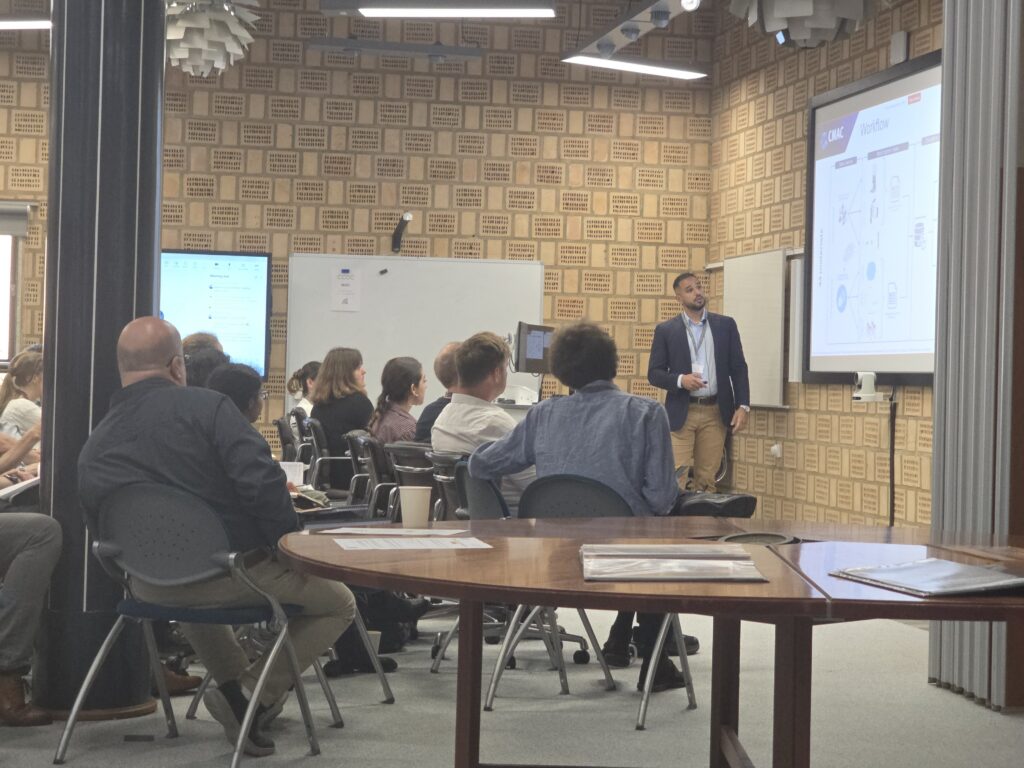
This year, we welcomed a group of students from the University of Oxford who are part of the ILESLA programme, a doctoral training programme led by the University of Oxford in partnership with Oxford Brookes University and The Open University. The programme provides interdisciplinary PhD training in the life and environmental sciences, combining taught coursework, rotation projects, and collaborative research opportunities across academia and industry.
Two groups of students presented their short project research from the past year, carried out in collaboration with CCDC Discovery Science researchers:
Stanislavs Kurass is a first-year DPhil student participating in the ILESLA programme with Elisa Villacampa Teixeira, Inka Snellman, and Hannah Pitchford. As part of a team challenge project co-supervised by Andrei-Vlad Badelita and Kepa Burusco-Goni, they are exploring how machine learning can be used to create compact molecular descriptors bridging 3D structures and Electrostatic Potentials that better capture the properties relevant to protein–ligand binding and molecule similarity.
Naomi Costello is also a first-year DPhil student participating in the ILESLA programme, and her team is developing a drug-like subset of the CSD by applying computational filters based on Lipinski’s Rule of Five and beyond. The project aims to identify molecules with properties associated with good oral bioavailability and to create a curated dataset to support drug discovery and molecular design workflows.