Explore our structural chemistry software here, to support research in drug discovery, particle behaviour, solid form analysis and functional materials design, all using the world’s largest crystal structure database: the Cambridge Structural Database (CSD).
Our mission is to advance structural science for the public benefit — here you can explore and access our free data, software, training support and educational resources.
As well as providing data and software, we also conduct research and regularly publish on topics around structural chemistry and data science, collaborating with leading researchers, in both academia and industry.
Helping you get the most out of the CSD data and software, use these pages to get support, find licensing information, view documentation and other resources, and download software.
Explore our structural chemistry software here, to support research in drug discovery, particle behaviour, solid form analysis and functional materials design, all using the world’s largest crystal structure database: the Cambridge Structural Database (CSD).
Our mission is to advance structural science for the public benefit — here you can explore and access our free data, software, training support and educational resources.
As well as providing data and software, we also conduct research and regularly publish on topics around structural chemistry and data science, collaborating with leading researchers, in both academia and industry.
Helping you get the most out of the CSD data and software, use these pages to get support, find licensing information, view documentation and other resources, and download software.
As a non-profit organisation, the CCDC exists to serve a global scientific community, and it is that community that makes what we do at the CCDC so special. This blog recognises how members of that community shape who we are through our Board of Trustees.
Since 1965, the Cambridge Structural Database (CSD) has been built from contributions from researchers worldwide, and today, a global network of scientists uses it every day to discover and advance their research.
It isn’t just data that members of the community contribute. It also requires time, expertise, and a genuine passion for advancing science for the public benefit, closely aligned with the charitable purpose of the CCDC. We strive to support the community we serve by curating the CSD, developing tools to make the data more usable and accessible, and helping to train and inspire the next generation of structural scientists.
A community that shapes us
That same sense of community is reflected in how the CCDC is governed. We are guided by an international Board of Trustees, whose expertise and commitment help shape our direction. They ensure that all our decisions put the needs of scientific research first. As volunteers, they bring a diverse range of perspectives from academia, industry, publishing, and data science, as well as expertise spanning crystallography, chemistry, business, and beyond. They meet regularly throughout the year, both virtually and in person, providing insight, challenge, and support as we shape the future of the CCDC together. Each Trustee is initially appointed for a four-year term and can serve up to two consecutive terms.
The board currently comprises seven members drawn from across the community, and over the years, the CCDC has been privileged to be guided by more than 40 trustees. Each trustee has brought their own expertise and perspective and has played their part in ensuring the CCDC has continued to have an impact on researchers worldwide over 60 years after it was first established.
Our list of board alumni is truly impressive and includes many distinguished names, such as Mary Rosaleen Truter, Baron Phillips of Ellesmere, Jack Lewis, Baron Lewis of Newnham, Sir David King, Dame Louise Johnson, and Professor Jack Dunitz, to name but a few. It is always bittersweet for us when a trustee comes to the end of their term. It is sad to see them depart, although for most, the connection stays, and we also get the pleasure of recruiting our next trustee. With our May Board meeting now behind us, we are in one of these phases of transition.
Susan Bourne, Professor of Physical Chemistry at the University of Cape Town, is stepping down as Chair after serving for the past two years, but will remain on our board. She will be succeeded as Chair by Nigel Pitchford, a trustee since 2020 and CEO at Venture Capitalist, who will take on the role for the next two years. Ye Li, Director, Science & Agriculture Libraries at Cornell University Library, is also taking on the Vice Chair role within the board.
Alessia Bacchi
In May 2026, we said a heartfelt thank you to Alessia Bacchi, who stepped down from the board after eight years of service.
Alessia, Professor of Inorganic Chemistry at the University of Parma, has had a long and close connection to the CCDC. Like many crystallographers, she began using the CSD early in her career. Her first structure, from her Master’s project, was published in 1993 (CSD refcode PEBMAK). Since then, Alessia has deposited many more structures, published widely using insights from the CSD, and played a key role in training the next generation of scientists, often using the CSD in her teaching and outreach activities.
Throughout her eight years on the board, Alessia brought invaluable insight and experience, shaped by her deep connections across the crystallographic community and her long-standing relationship with the CCDC.
During her farewell speech at the CCDC office in Cambridge, Alessia shared how she felt when she first joined the Board of Trustees.
Alessia Bacchi
“When I started eight years ago, I felt as if I belonged to this place forever. It’s this strong feeling of belonging that makes the CCDC community so special.”.
She also reflected on the positive and collaborative approach the board brought to working together. Alessia will continue to work closely with the CCDC as a CSD Champion, a role she has held since the network was established in 2021. Ilaria Gimondi, Training, Education and Outreach Team Leader, reflects: “We are very grateful for her contributions and for sharing her expertise in chemistry education during our regular meetings, and we look forward to continuing to work with Alessia for many years to come.”
The CSD Champions network includes researchers, teachers, and educators from around the world who provide feedback and guidance to help shape the CCDC’s Training, Education, and Outreach work. They also support training on CCDC tools in their regions and help their communities access and use the CSD.
A heartfelt thanks
“We are very grateful for the commitment and insight our Trustees bring to the CCDC. Their guidance and thoughtful challenge play a vital role in shaping what we do. On a personal note, Susan’s and the wider board’s support and guidance during my first year as Executive Director have meant a great deal to me, and I am incredibly grateful to both her and Alessia for their contribution and shared commitment to the CCDC.” Suzanna Ward, Executive Director of the CCDC.
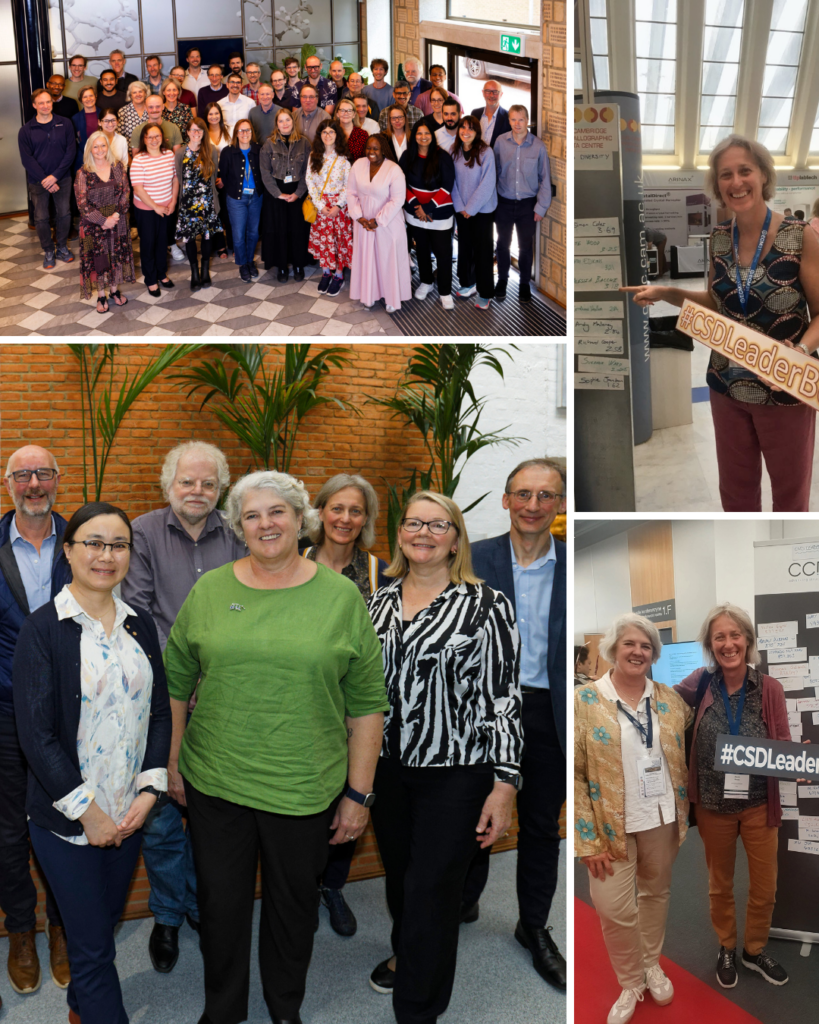
Memorable moments with the Board of Trustees visiting the CCDC office (UK); Alessia joining the CSD Leaderboard at ECM 2018 in Oviedo (Spain); and Susan and Alessia with the CSD Leaderboard at ECM 2025 in Poznan (Poland).