
New Structures Added to the Cambridge Structural Database
The Latest Cambridge Structural Database Update
The Cambridge Structural Database (CSD) now contains 1,410,034 structures (1,451,367 entries), supporting scientific research internationally across many different fields including pharmaceuticals, agrochemicals, materials science, and more.
14029 new structures (15248 entries) have been added to the CSD in this update. Out of these 15248 entries, 8368 (55%) are organic and 6880 (45%) are organometallic.
Included in this update is this impressive structure (CSD Entry FAHSAN) featuring a cyclo tribismuth ring with all-metal aromaticity, reported by Liddle et al. (http://dx.doi.org/10.1038/s41557-026-02123-8). The ring represents the heaviest 6p analogue of cyclopropenium and is isolated as inverse-sandwich complexes with uranium and thorium. The aromaticity is calculated to be dominated by sigma-orbital contributions with a ring current comparable to that of benzene.

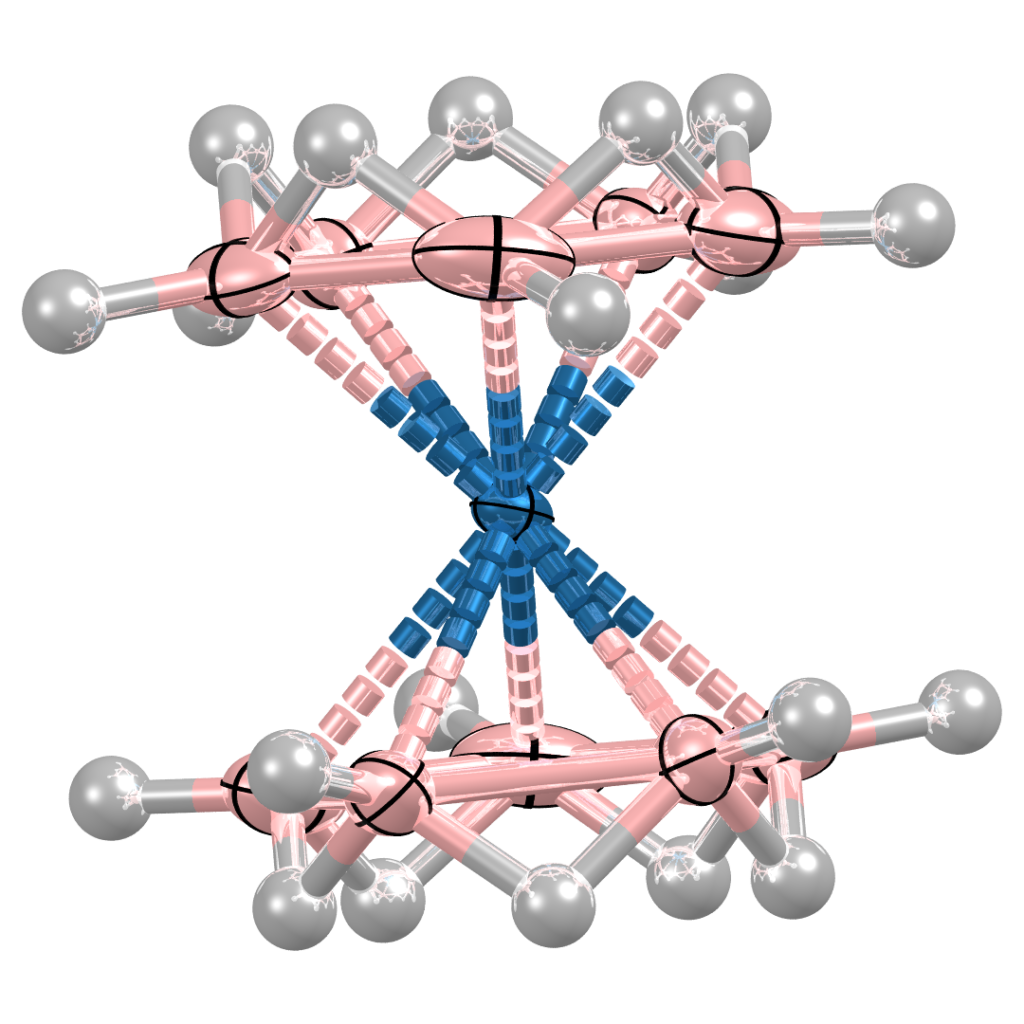
Another fascinating structure is CSD Entry UBUGOS, a carbon-free analogue of ferrocene, [Os(B5H10)2], reported by Jemmis and Ghosh et al. in Science (http://dx.doi.org/10.1126/science.aed9192).
CSD Entry QAJNID provides unambiguous stereochemical proof of the revised side-chain configuration after the first asymmetric synthesis of a mangicol sesterterpene reported by Maimone et al. in JACS (Asymmetric Total Synthesis and Structure Revision of (+)-Mangicol D).

How to Get the Update
All available software or data updates can be applied by using the CCDC maintenance tool in the installation and selecting the Check for Updates option. If you have any questions, our support team will be more than happy to help.
Next Steps
- To discuss further and/or request a demo with one of our scientists please contact us via this form or email us at hello@ccdc.cam.ac.uk.
- Check out the CSD for yourself and see how your research can benefit from the combined knowledge of over 1.4M small-molecule organic and metal-organic crystal structure data.
- Proprietary data? Our team can curate your proprietary data into a Cambridge Structural Database (CSD)-like database, accessible through a simple browser-based interface. This is all done within your firewall to comply with your data security requirements.
- More information on CSD software trusted by academic and industrial institutions around the world.
- See case studies of the CSD in action, driving forward the boundaries of scientific research.
- Stay up to date on the latest CCDC news, events and webinars, as well as CSD data and software updates. Sign up to our newsletter.